When Ibiza Was Gay: The Bars, the Bodies and the People Who Made an Island
From Chiringay and Sunrise to Dôme, La Troya and the people behind the spectacle: remembering a gay world whose influence reached far beyond its size.
There is a sentence that returns whenever people talk about the Ibiza they miss: Ibiza used to be gay.
I understand the loss contained in those words. They describe an island where gay life seemed to help set the tone: the clothes, the humour, the music, the people who made an entrance and the people who knew everyone.
But I would not finish the sentence by declaring that Ibiza has no queer life left. That would erase the people still living, working and creating there. What this history asks is more precise: how did a gay social world become so influential, and what happens when the places that connected it disappear or lose their centrality?
Before the itinerary, there was a network
The old island cannot be understood through a list of famous discotheques alone. The beach, the small bar, the terrace, the street parade and the dancefloor belonged to a connected social landscape.
A person you met in the afternoon might be working in a bar that evening, performing in a parade later and dancing beside you after dawn. That is the kind of connection described in the testimony and contemporary reporting behind this article. It should not be confused with a claim that every person experienced the same freedom.
Nor should Ibiza’s mythology turn Spanish history into a fairy tale. A historical study of nightlife between 1950 and 1971 documents fines for alleged breaches of morality and restrictions on entertainment. The island’s reputation for escape developed within a country that also practised repression. Historical research: nightlife and tourism, 1950–1971
Chiringay: the part of the story lived in daylight
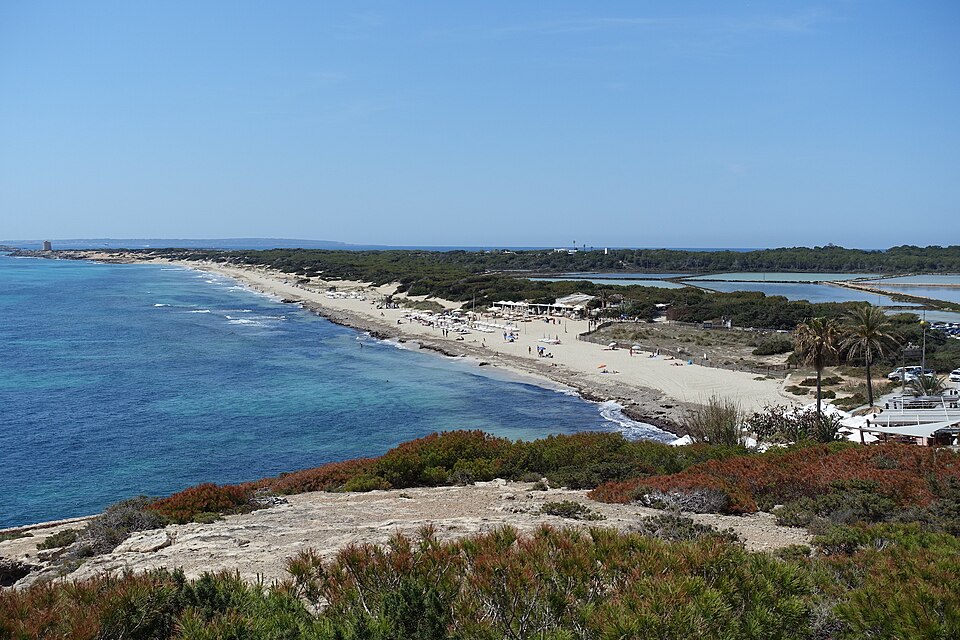
For this memory, Chiringay at Es Cavallet belongs near the beginning. A gay destination needs more than somewhere to spend the night. It needs places where people can meet again in daylight, recognise one another and extend a friendship beyond a dancefloor.
On 15 June 2026, local newspaper Periódico de Ibiza reported Chiringay’s announcement of permanent closure after 45 summers. Its account names Alberto Ciatera and records the family’s farewell to the customers who had returned across generations. Contemporary report of the closure
That is a documented ending, not simply a feeling that the old days were better. It means a recognisable meeting point is gone. The beach remains; the social arrangements built around a particular business do not automatically survive it.
I would be cautious about giving that closure a single explanation. The family’s farewell does not establish a complete causal history. For this article, the important distinction is between mourning the venue and claiming that Es Cavallet itself has ceased to matter to gay visitors.
Sunrise, Dôme and the streets before the clubs
Sunrise belongs to the historic constellation around Calle de la Virgen — Carrer de la Mare de Déu — and the nearby streets of Ibiza Town. Dôme, near the old town walls, occupied another important place in that pre-clubbing geography.
A 2007 DJ Mag guide places Sunrise and Dôme alongside JJ, Indira, Co-Fusion, Ethno, La Nada, Cheri, Angelo and Soap Up. It also records a separate Figueretes circuit including Kitsch, Monroes, Magnus, C.U.B.E and Island Bar. This is a historical snapshot, not a claim that all those businesses still operate. DJ Mag’s 2007 scene guide
The significance of that list is its density. There were multiple places to find a familiar face before committing to the expense and scale of a superclub. A bar could be an introduction, a workplace, an informal information desk or the whole night.
Remembering those rooms means remembering the people behind the counter, too. They helped turn international visitors into returning guests, and returning guests into something closer to a community.
Soap, Lola’s, Monalisa and Anfora
Period descriptions of Soap identify Julio and Marcus as its owners and describe the relationship between the former Incognito premises, Soap Up and the Lola’s space known as Soap Club or Soap Down. These names and arrangements changed; the point is the cluster of connected places around the terraces and steps. Archived Soap guide
Monalisa appears in Anna Maria Riccò’s own account of island life. In a 2015 interview she names Paolo Bottaro and Alberto Luis Romero as the hosts whose hospitality made it a point of return. That is a valuable reminder that the professional skill of welcoming people belongs in nightlife history. Anna Maria Riccò interview
Anfora represented the more specifically gay club experience. It is now listed as closed, and later interviews about the island identify its disappearance as a loss. I have not established a sufficiently reliable closure date to print one here. Anfora archive listing
Brasilio de Oliveira: the work behind the fantasy
Brasilio de Oliveira is central to the relationship between Ibiza’s gay world and its theatrical nightlife. La Troya’s history reaches back to his work at KU, later Privilege, and the earlier La Vaca Asesina identity.
In a 2026 interview, current La Troya director Eduardo de Oliveira describes an approach that made the audience part of the event. Costumes, carnival, themed environments and street processions connected the club to the wider island. The history runs through Amnesia, Space and subsequent homes. Eduardo de Oliveira on La Troya’s history
Brasilio died in 2020. Remembering his contribution should involve more than the word legendary. A successful illusion requires recruitment, rehearsal, organisation, visual decisions and the ability to make very different people feel that the party includes them.
That labour helped create the freedom people remember.
Baby Marcelo: a performer, not an accessory
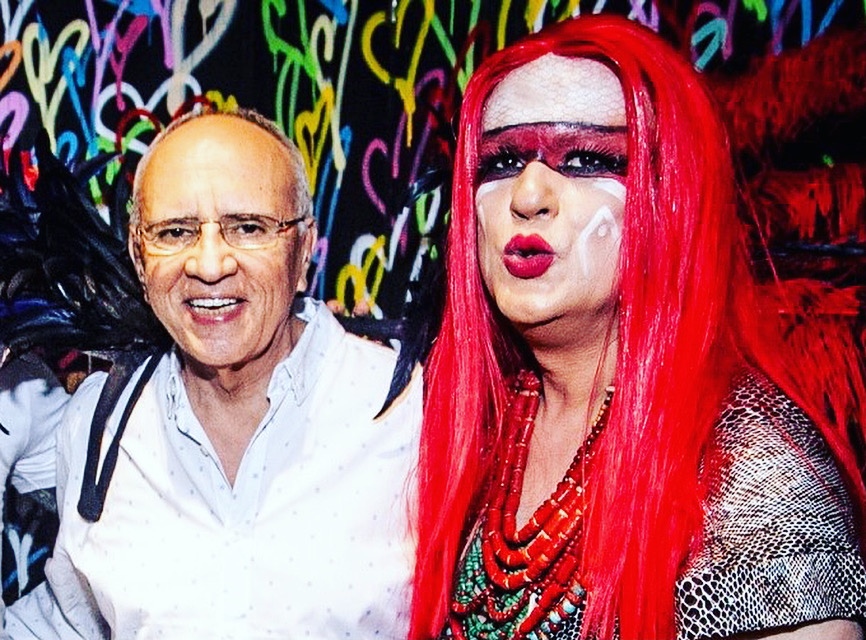
Baby Marcelo is a person; La Troya is the party and creative world with which he became closely associated. The distinction matters.
In a Mixmag Spain interview, the Italian-born artist describes a theatrical background and a practice spanning transformation, mime, stilts, voice and painting. He identifies influences including Lindsay Kemp, Lee Bowery, Divine and Nina Hagen, and credits Brasilio as an artistic mentor. The same interview documents The Face of Ibiza, his project with DJ Oliver. Baby Marcelo in his own words
The costumes are memorable. So is the skill involved in taking command of a room. A host can release the tension of a crowd, make theatrical excess feel participatory and give a night a recognisable character.
I want to remember that as artistic work, rather than reduce a performer to a colourful photograph beside a DJ.
Anna Maria Riccò: the person who connects the room
Anna Maria Riccò, also known in Ibiza recollections as Day and Night, belongs to the history of public relations, dancing and human connection.
Her 2015 interview describes beginning in a gay bar, dancing at Pacha and later working in public relations across its programme and La Troya. In 2008, El País had already identified her as a veteran of island nightlife and recorded her concern that visitors were bypassing the port bars by going straight from hotels to clubs. Her career recollections · El País, 2008
That observation reaches the heart of this story. When the route changes, the small meeting places can lose their audience even while the big dancefloors keep selling tickets.
Her contribution also challenges the habit of remembering nightlife exclusively through men behind turntables. The person who introduces people, keeps a relationship alive and understands a room can be as essential to a scene as its headline act.
The parties: a historical roll call
These names belong to different periods and different formats. Some were gay-centred; others were mixed or polysexual events with strong queer participation. Their inclusion is not a statement about any individual organiser’s sexuality.
- La Vaca Asesina / La Troya Asesina / La Troya: Brasilio’s evolving theatrical lineage.
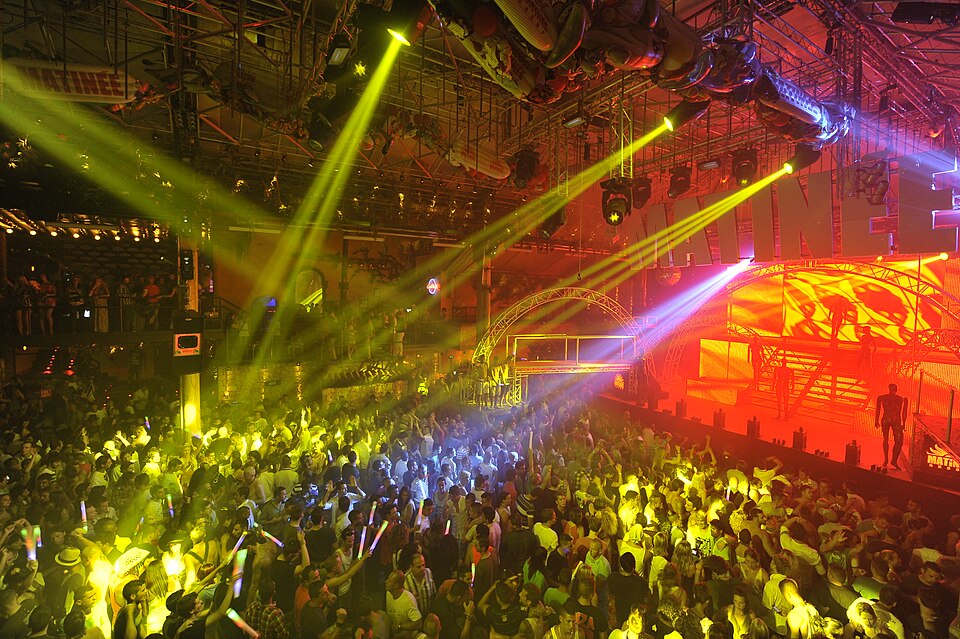
- Matinée: a major name in the Spanish gay-clubbing circuit, with an important Space chapter.
- Scandal / Just Scandal: documented at Pacha and in later incarnations elsewhere on the island.
- Gorgeous Ibiza: another gay-scene-rooted party that reached larger venues.
- Manumission: a mixed, sexually theatrical production with a strong connection to KU’s gay social world.
- Café Olé, SuperMartXé and The Face of Ibiza: further parts of the island’s performance-led club history.
- Glitterbox: a later chapter in disco, house and expressive performance, rather than a party from the same era as KU.
Contemporary reporting documents Scandal at Pacha in 2003. DJ Mag’s 2007 guide places Matinée, Just Scandal and Gorgeous within that season’s club landscape. Baby Marcelo’s retrospective identifies the wider group of performance-led events. These are historical connections, not a current weekly schedule. Scandal, 2003 · Scene guide, 2007 · Marcelo’s retrospective
The DJs and promoters deserve their names
The archive gives us DJ Oliver at La Troya; J.Louis and Ior-dee in Matinée’s 2007 programme; DJ Kae at Just Scandal; and Tommy Vee, Mauro Ferrucci and Gianluca de Tiberiis associated with Gorgeous. It names Manolo Soria with Matinée and Paola Cuervo with Gorgeous. Contemporary credits, 2007
La Troya’s more recent accounts also credit César de Melero, Oscar Colorado, Paul Darey and Felix da Funk, while its official site identifies Oscar Colorado and Rampini as DJs, Eduardo Oliveira as director and Evora Luanda as a visual artist. These credits describe different chapters; they should not be flattened into one imaginary line-up. La Troya history · Official creative credits
Alfredo Fiorito belongs to the wider musical foundation. His eclectic Amnesia selections helped define Balearic club culture. That is a musical connection, not a label for his sexuality or a claim that Amnesia was an exclusively gay club. The birth of Balearic
A fuller DJ archive: who played which rooms?
This is an expandable roll call of documented participants, not a complete personnel register. A listing establishes an appearance or a stated role in a particular period; it does not establish a lifelong residency, sexual orientation or membership of one collective.
- La Troya and its later chapters: DJ Oliver, César de Melero, Oscar Colorado, Paul Darey and Felix da Funk; later programmes and reviews also document Camilo Franco, Rampini, Cristian Battaglia and Ginevra Ramos. Historical overview · HEART review, 2017
- Matinée: J.Louis and Ior-dee in the 2007 guide; Lydia Sanz, Andre Vicenzzo, Flavio and Dick Ray in a June 2012 Amnesia review. These are different seasons. Matinée eyewitness review
- Just Scandal: DJ Kae is identified as its longstanding resident in the 2007 scene guide. Period reporting
- Gorgeous at Space: a September 2007 closing listing names Tommy Vee, DJ Ariel, Oliver Lang, Sebastian Gamboa, Gianluca de Tiberis and Atxur; the broader contemporary guide also credits Mauro Ferrucci and Wayne G. Archived closing-party line-up
- Café Olé: Space’s own archive identifies Rafha Madrid as a resident. Its thirteenth-anniversary programme lists Francesco Farfa, House South Brothers, Paul Darey, Danny Leblack, Danila, Oscar Cano, Miguel Garji, Peter Le Cool and Marcoloco, with Patrizze performing live. Resident profile · Anniversary programme
- Another Café Olé chapter: an official closing report credits Superlush DJs, Javi Always, Iordee, Rafa Ariza, Luque y Velarde, Liz&Baker, Juanra Martínez, Gabriel Cubero, Allan Ramírez and Lee Stark. It separately credits vocalist Rebeka Brown and her collaboration with Taito Tikaro, alongside performers Miss Davidolta and Diana de Lucero. Vocalists and performers belong in the credits, without being relabelled as DJs. Space’s closing report
- SuperMartXé, 2015: the season’s press announcement names Alex Guerrero, Abel The Kid, Javi Reina, Manuel de Diego, AB García, Salva di Nobles and Valcar, plus Brian Cross as a guest resident; Nalaya is credited for live vocals. A later ticket listing also documents Juanjo Martin. 2015 press announcement · Archived SuperMartXé billing
- The wider Space and Balearic world: the 2007 Space closing programme includes Alfredo, José Padilla, Danny Tenaglia, Smokin’ Jo, Jonathan Ulysses, Steve Lawler, David Moreno, Joan Ribas, Claudio Coccoluto, Francesco Farfa, Elio Riso, Wally Lopez and Camilo Franco. This was a mixed club’s closing event, not an exclusively gay party. Space closing archive, 2007
These names make the history more audible. They also show why no single musical label can explain the island: residents, visiting selectors, vocalists and performers contributed in different combinations, in different rooms, over decades.
The animation was part of the authorship
Go-go dancers, drag artists, acrobats, costume makers and street teams were not simply filling time between records.
In Claire Davies’s account of Manumission, Dôme appears as a meeting place for performers who later worked in the club. She also identifies Annamaria in an archive image. The recollection connects the bar, the characters and the production itself. Claire Davies on Manumission
A 2017 eyewitness review of La Troya at HEART records an aerial-silk performance, Baby Marcelo’s hosting and sets by Camilo Franco and Oscar Colorado. Those details show different disciplines shaping one event. La Troya at HEART, 2017
I would like our memory of Ibiza to make space for the workers whose names did not reach the flyer. A photograph can preserve a costume while losing the person who made, wore, repaired or transported it.
What changed?
There is no single switch that turned gay Ibiza off. Different changes overlap: disappearing venues, altered opening hours, new business models and the cost of remaining on the island.
A 2022 academic study records the importance of small LGBTQ-focused venues and the restrictions placed on afterhours culture, including the 2008 ban. That changed the structure of a clubbing day as well as the businesses around it. Research on Ibiza’s nightlife formats
Baby Marcelo describes the move towards a more globalised entertainment industry in his retrospective. Contemporary reporting on Amnesia also describes housing pressures and an increasingly expensive island. These are broader conditions; they do not prove the reason for every individual bar’s closure. Marcelo’s perspective · El País on the changing island, 2026
My interpretation is that the loss is partly about agency. A community can remain welcome as customers while becoming less central to deciding what a destination looks and feels like. Inclusion and cultural authorship are not the same achievement.
What remains, and what deserves remembering
La Troya operated at Chinois in the 2026 season. The island still has queer performers, residents, visitors and Pride activity. Declaring all that dead would turn nostalgia into another kind of erasure. La Troya’s 2026 season
But saying that some things survive should not dismiss the loss of Chiringay, Anfora or the old density of connected meeting places.
I want to remember Ibiza through the people who gave it texture: Brasilio creating a world, Marcelo giving it a face and a voice, Anna Maria connecting strangers, the resident DJ building a morning, the bartender remembering who had returned.
Perhaps that is what we mean when we say Ibiza used to be gay. We remember a place where gay life helped write the story, rather than merely buy a ticket to it.
That history deserves names, care and an archive. And the people still carrying it forward deserve our attention too.